

Software defines what a vehicle can do. Semiconductors make sure it works.
President & CEO Automotive division, Infineon Technologies
The software-defined vehicle (SDV) is no longer a vision – it’s a strategic focus for the entire automotive industry. Today’s decisions on vehicle architectures will determine how quickly innovation can scale, how securely systems can evolve and how economically they can be sustained.
Around 10% of all new produced cars feature a mixed domain / zonal architecture. By 2030, this share could increase to around 40%. In addition, SDVs can significantly accelerate the market penetration of automated driving. About 30% of all new cars currently feature driver assistance and automated driving functions – a figure that could rise to approximately 55% by 2030.
Yet every software capability relies on a hardware foundation. While over-the-air software updates are possible throughout the vehicle’s lifetime, hardware decisions have to be made up front, thus defining the scope of software evolution.
The Hidden Force Behind the SDV
The wrong silicon choices lead to delays, feature de-scoping and expensive rework; the right choices align computing, connectivity, power distribution and cybersecurity, enabling seamless over-the-air updates, software reuse across platforms and cutting total lifecycle cost. The right silicon decision can reduce wiring in zonal E/E architectures by up to 600 meters and can deliver approximately 20% higher energy efficiency using smart power distribution.
Software sets ambition. Semiconductor hardware determines execution: latency, safety, security, energy efficiency and lifecycle upgradability.
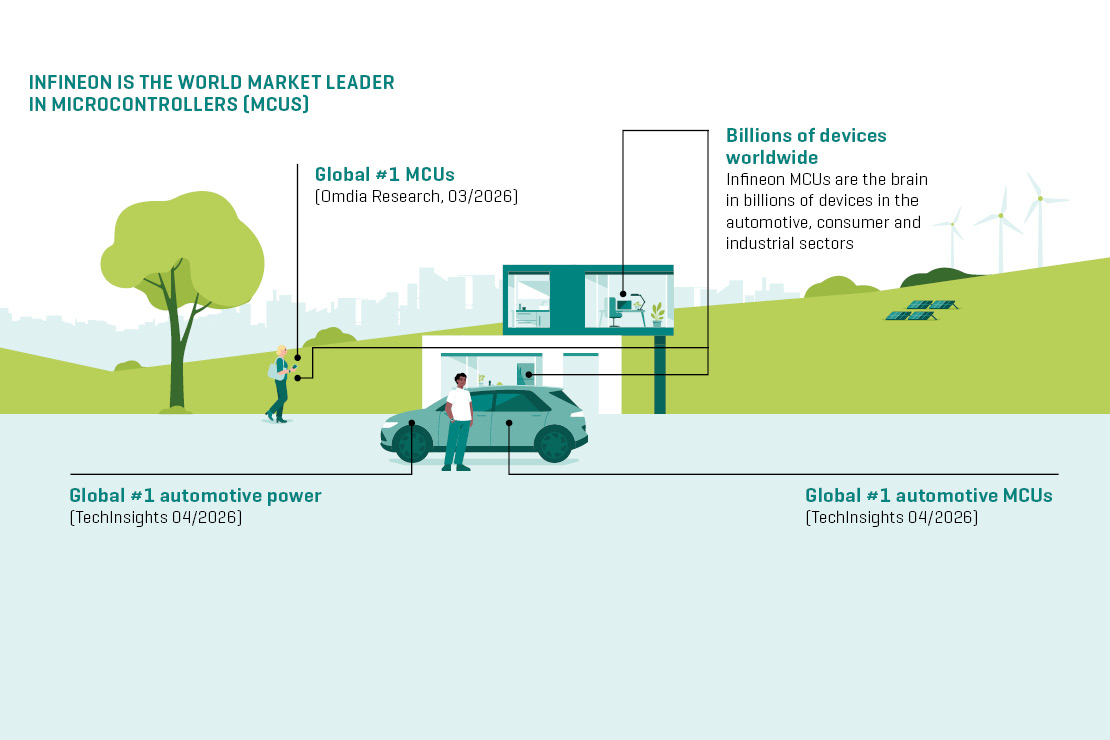
Microcontrollers, or MCUs, are at the core of this execution. This changes the weight of semiconductor decisions for car manufacturers investing billions in software platforms. Thus the success of the SDV comes down to one key question: Who delivers semiconductors and MCUs, backed by true system understanding, to make SDVs thrive?
Debunking SDV Architecture Microcontroller Myths
Computing architectures and vehicle networks are becoming increasingly centralized as zonal concepts gain traction. The role of automotive MCUs is frequently questioned in this evolving environment.
Four technology myths deserve closer examination.
Myth 1: MCUs will be replaced by Microprocessor Units (MPUs) as zonal architectures mature.
Reality says otherwise. Zone is a spatial term and does not refer to computing performance. MCUs process data in real time, decreasing in-vehicle data traffic and enabling deterministic, safety-critical control.
Infineon’s AURIX™ TC4x microcontroller, for example, delivers real-time performance and functional safety that MPUs cannot provide for actuator control and power distribution.
Myth 2: High-Performance MCUs cannot match MPU capabilities.
This fundamentally misunderstands design objectives. Modern high performance MCUs deliver over 40,000 DMIPS with hardware-enforced safety partitioning, integrated hardware security modules and sub-microsecond interrupt latency.
Myth 3: MPUs will absorb MCU functions in real-time applications.
Functional safety makes this impractical. Real-time control loops require dedicated resources with guaranteed latency. Zonal architectures add decentralized control close to physical actuators.
Myth 4: MCU demand isn’t solely dependent on the drivetrain.
Electric cars require significantly more MCU content than their combustion counterparts. Battery management, inverter controls, DC-DC converters and chargers each demand dedicated microcontrollers. Electrification accelerates MCU adoption rather than limiting it.
Accelerating the Path to Production
While computing is a key hardware pillar in SDV, it’s not the only one. Car manufacturers need semiconductor partners who provide system-level understanding across computing, connectivity, power and security – and who can translate that into production-proven semiconductor solutions, reference designs, validation frameworks and toolchains that shorten schedules and de-risk launches.
This is the basis of Infineon’s SDV strategy. It aims to support car manufacturers with an exceptionally broad and well aligned semiconductor product portfolio. Car manufacturers can significantly accelerate their SDV development by leveraging proven hardware and system solutions. Infineon combines high-performance computing platforms and secure high-speed connectivity with smart and efficient power distribution to provide a holistic foundation for dependable car architectures.
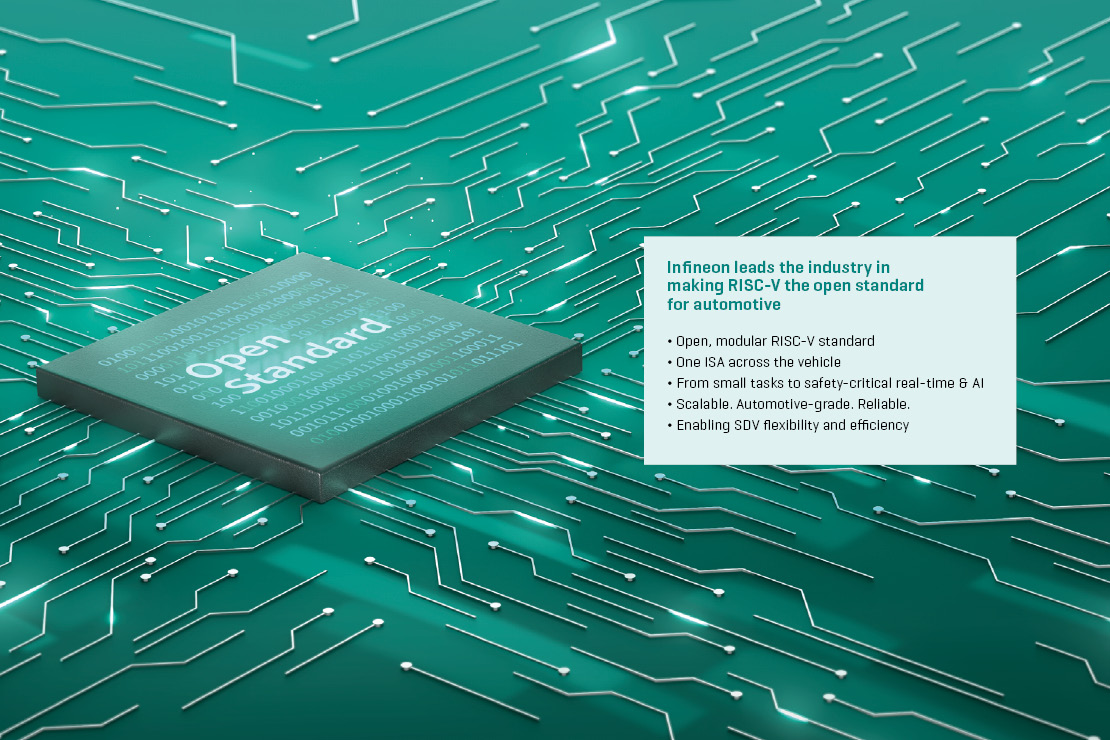
Just a few examples: The AURIX™ TC4x family represents Infineon’s flagship real-time MCU platform with state-of-the-art TriCore™ processors and comprehensive cybersecurity. A growing RISC-V roadmap adds flexibility and long-term scalability. For connectivity, Infineon’s BRIGHTLANE™ Ethernet portfolio supports the multi-gigabit data rates essential to sensor fusion with time-sensitive networking integration. Power distribution safety elements like PROFET™ Wire Guard eFuses not only enable functional safety, they also contribute significantly to improved energy efficiency.
SDV Deployment
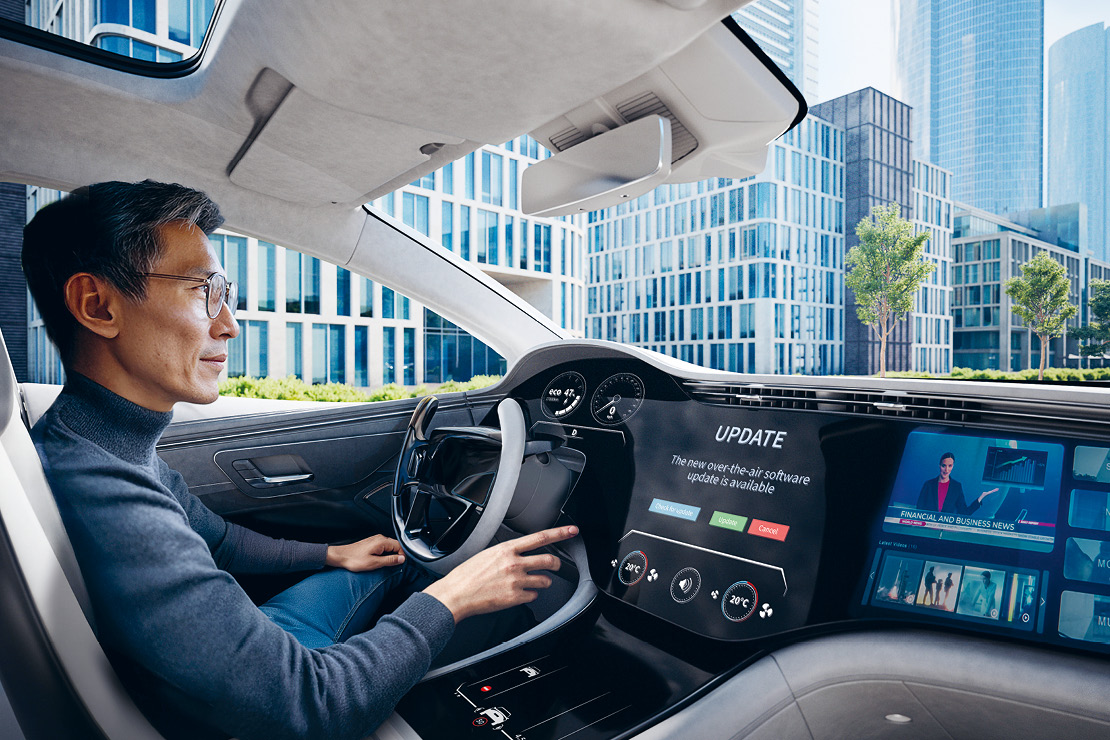
Next generation automotive architectures already demonstrate how Infineon delivers tangible impact in real-world SDV applications. These architectures integrate Infineon key components driving central computing, high-speed connectivity and efficient power management. By decoupling software from hardware, the architectures support seamless over-the-air updates and let automakers respond quickly to evolving user requirements.
SDV Architectures Are Shaping What Comes Next
The SDV race is a new software strategy transforming E/E architectures. And it’s only the beginning. SDVs represent the technological bridge between today’s connected cars and tomorrow’s autonomous systems.
Semiconductors for centralized computing, real-time control, secured connectivity and intelligent power management are the foundation of trust.
Every SDV put on the road today is an AI-supported learning system and a further step toward safe and secured autonomy. The automotive future will emerge where software intelligence meets hardware reliability – and where semiconductors turn vision into affordable user experience.