

In Dialog with Roberto Henkel
Mr. Henkel, industrial manufacturing is on the verge of a massive upheaval. What is Schaeffler’s vision of the future of manufacturing?
With our smart factory approach, we are strategically driving digital innovations in our factories around the world and shaping the future of industrial manufacturing through the use of state-of-the-art technologies. We continuously monitor and evaluate new digital developments on the market and transfer promising solutions to concrete applications.
Our vision is to realize a so-called sentient factory, a factory that is not only automated but also has the capacity to perceive, think, learn, and optimize itself independently.
A key component of this transformation is your partnership with NVIDIA. What specific role does this technology leader play for Schaeffler?
No company can make the leap to physical AI on its own. We need strong ecosystems. The collaboration with NVIDIA is a catalyst for us.
Using NVIDIA Omniverse, we can faithfully depict all elements of our real manufacturing processes in virtual space. The exciting thing about this is the symbiosis: NVIDIA supplies the pioneering platform for digital twins and AI computing. Schaeffler contributes decades of manufacturing expertise and the technological know-how needed to operationalize these systems on an industrial scale.
That sounds like an ambitious project. When do you expect to have this technology rolled out on a larger scale in your plants?
Our goal is to integrate at least half of all Schaeffler plants worldwide into the Omniverse by 2030.
We focus here on reducing the so-called sim-to-real gap – that is, the gap between the virtual simulation and the actual behaviors of the machines in the physical plant. The smaller this gap becomes, the faster and more agile we become.
Digital twins have been around in industry for some time. How does your approach in the Omniverse differ from classic 3D models?
The decisive difference lies in the physics-based simulation. While classic models are based on visualizations, in the Omniverse, we can accurately depict reality, including physical laws such as those governing force, friction, torque, and material behavior.
In this way, we can minimize errors, among other things. We virtually test new processes and complex assembly processes before the first real machine is ever built. As a result, our costs are lowered, because the need for physical prototypes and downtimes for new product launches is significantly reduced. At the same time, development and commissioning times are slashed.
Once you can perfectly simulate the digital factory, the next step is to move on to autonomous systems. Does the path almost automatically lead to physical AI?
Yes, because the precise digital simulation of the environment is the neural foundation. Only when the AI virtually understands the space and the processes can we safely transfer this »brain« to physical systems. The result is physical AI: adaptive assistance systems, sophisticated, seeing robot grippers, and, ultimately, humanoid robots. The boundary between the virtual twin and the real-world application dissolves.
This brings us to the subject of humanoid robots, which are currently electrifying the tech world. Why is this field so relevant for a motion technology company such as Schaeffler?
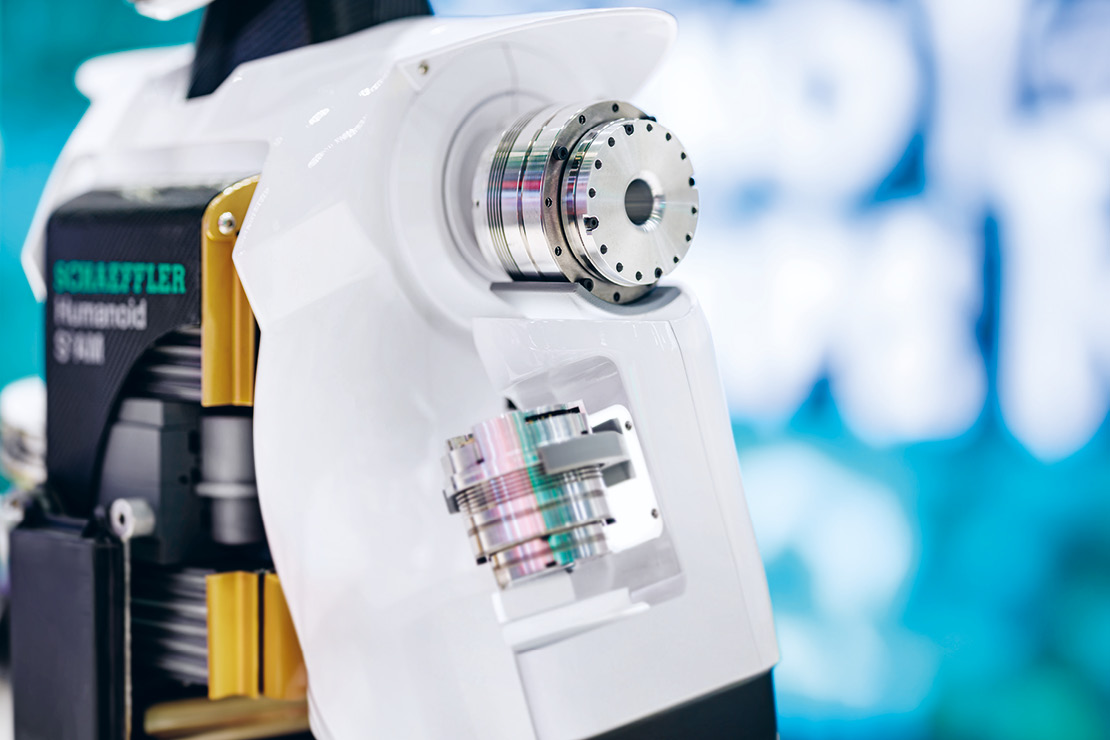
For Schaeffler, humanoid robotics is a promising growth area with a great deal of industrial potential. As a leading motion technology company, we are actively contributing to its advancement – both by using it at our manufacturing plants around the globe and by supplying key components for it.
This is where our strengths come into play: with our decades of experience, industrial manufacturing expertise, and proven resources, we can realize fast and flexible production ramp-up and scaling of delivery networks and make high-quality products available in the shortest time.
Our vision is to realize a so-called sentient factory, a factory that is not only automated but also has the capacity to perceive, think, learn, and optimize itself independently.
For what specific tasks do you plan to use humanoid robots on the shop floor?
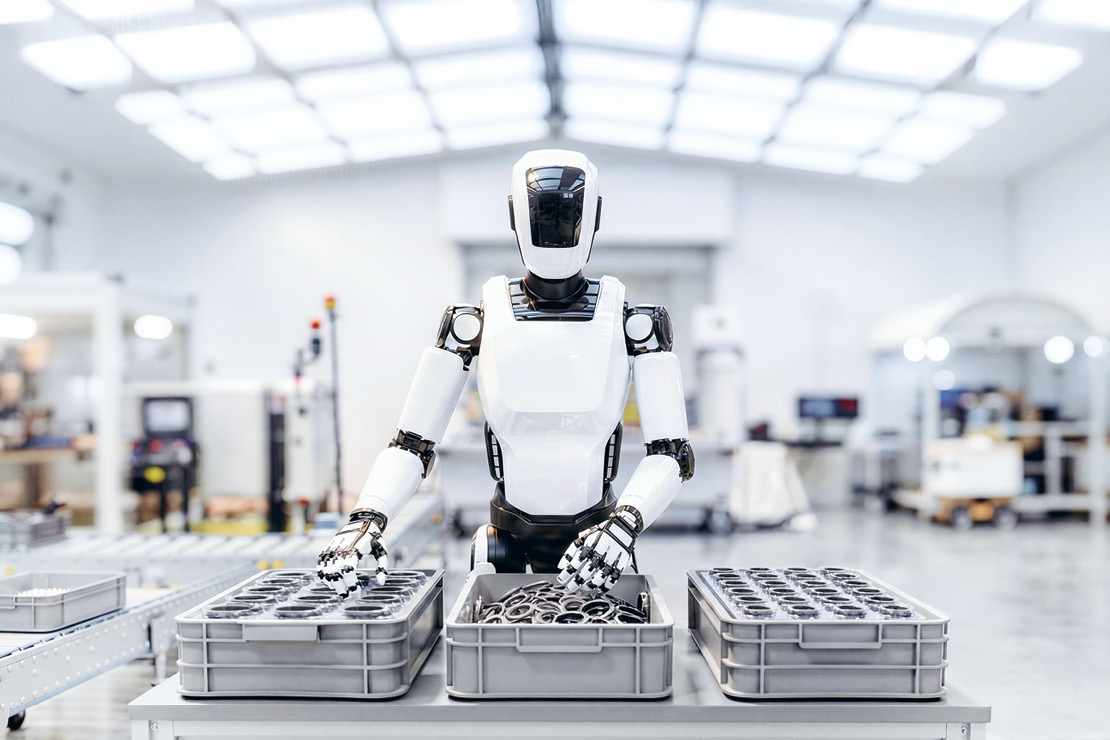
Humanoid robots are used to complement humans in a synergistic way and perform repetitive, strenuous tasks that involve ergonomic hazards. Typical applications at our plants include the autonomous movement of parts between warehouses and lines in materials handling and intralogistics, material staging, tool changing, and parts placement on manufacturing lines, and flexible handling tasks such as assembly and packaging tasks in which human-like kinematics are advantageous.