

In Dialog with Ozgur Tohumcu
Ozgur, you’ve spent years at the intersection of industry and technology, working with the world’s leading automotive and manufacturing organizations. From your perspective, what is the single biggest pressure facing automotive leaders right now?
Speed. Without question. I talk to automotive and manufacturing customers every day, and the conversation always comes back to the same conviction: the industry must move faster. Research shows that new entrants are getting vehicles to market in nearly half the time of traditional automakers. What used to be a four-to-five-year cycle is now an 18-month imperative. That doesn’t mean incumbents have been doing it wrong – it means the world around us has changed.
Consumer expectations shift incredibly fast. People don’t want to drive a vehicle that feels like it was designed five years ago. But the real challenge is that you can’t just declare speed as an outcome. To truly move faster, you have to make it an organizational mindset – how quickly you design, develop, and validate products, and how decisively you make choices about what to build, what to buy, and what to partner for. At its heart, speed is about the velocity of decision-making.
How do automotive companies move faster while also managing growing complexity?
That’s exactly the paradox. In 2000, the average vehicle had about one million lines of code. By 2030, we expect that to be 300 million. Software is what makes modern vehicles exciting, but it’s also what makes them incredibly difficult to perfect.
Seventy percent of vehicle recalls in 2025 were software-related. So, the quality challenge is growing in direct proportion to the complexity of what we’re building. And at the same time, the environment around us is getting harder to navigate. Rising material costs, regulatory demands, economic uncertainty.
These pressures don’t pause while you’re trying to innovate, and you can’t solve this by adding more people or more process. On top of all that, consumers now expect deeply personalized experiences at every touchpoint, from how they discover a vehicle to how they interact with it every day. That means your systems have to be intelligent enough to know the customer, not just the product.
The companies that will lead are the ones breaking down silos between design, simulation, manufacturing, and operations, building connected, data-driven systems that respond in real time to both operational complexity and customer expectations.
When an engineering team can simulate a production line change before making a single physical adjustment, or collapse weeks of analysis into hours, that’s when agility becomes real. Not just reacting faster, but seeing problems before they arrive and delivering experiences customers actually want. And increasingly, the technology making all of this possible is AI.
AI has been part of automotive for decades. What’s actually different now?
Think back to the early 1990s, when America Online (AOL) started sending CDs in the mail so people could get online. That wasn’t the beginning of the internet – the foundations go back to the 1960s. For decades, it was government, universities, and computer scientists using it for niche applications. Then companies like AOL made it accessible to everyone. That was the tipping point. We’re in exactly that moment with AI right now.
We’ve had AI in automotive for years – predictive maintenance, computer vision in manufacturing, training autonomous driving models. But now AI is being embedded into every system, process, and corner of the vehicle lifecycle. Today, it’s difficult to imagine any part of an automotive business that doesn’t depend on the internet. I believe we’ll say the same about AI within just a few years.
But the real transformation comes with agentic AI systems, networks of agents working together, end to end, autonomously making decisions and orchestrating complex workflows.
Everyone is talking about AI agents. How do you see AI evolving beyond the assistants we use today?
It’s helpful to think about this in stages. The assistants most people use today are reactive – you ask a question, you get an answer. They’re useful but limited. The next stage is AI agents, where instead of asking specific questions, you give the system a job to do. It executes ongoing tasks on your behalf and reports back on progress. But the real transformation comes with agentic AI systems, networks of agents working together, end to end, autonomously making decisions and orchestrating complex workflows.
Gartner predicts that 33 percent of enterprise software applications will include agentic AI by 2028, up from less than one percent in 2024. Think about automotive supply chains. They’re massive, global, unbelievably complex. No human team can monitor every supplier, every shipment, every invoice in real time. Now imagine a network of AI agents, one monitoring lithium availability, another watching transportation costs, another tracking regulatory changes, all coordinating toward a goal like reducing battery production costs by ten percent. Over time, the system doesn’t just meet the goal; it adapts to new conditions and makes the supply chain more resilient.
With so much excitement around AI agents, what separates success from failure at enterprise scale?
This is the critical question. Gartner estimates that over 40 percent of agentic AI projects will be canceled by the end of 2027 due to escalating costs, unclear business value, or inadequate risk controls. Experimentation is easy, but enterprise scale is hard. We talk with our customers about developing an »agentic AI mindset« built on five principles.
Start by working backwards from the business problem, not the technology. Treat data as your differentiator, because 80 percent of companies are now revising their data strategies to support AI. Data is the critical fuel, and quality matters more than quantity. Build trust through appropriate human oversight, because confidence in AI decisions is what drives adoption.
Demand the best price performance, because cost-effective scaling is essential for sustained investment. And embrace multi-agent environments, because the future is not a single agent solving one task. It is multiple agents collaborating and orchestrating across complex workflows.
You’ve laid out what it takes to succeed with agentic AI. How is Amazon helping automakers put that into practice?
This is something our customers increasingly ask – what can the breadth of Amazon bring to their businesses? Not just AWS, but Amazon Leo delivering low-latency satellite connectivity to vehicles and factories anywhere on Earth. Amazon’s custom silicon – Graviton, Trainium, Inferentia – giving Original Equipment Manufacturers (OEMs) the AI compute economics to run workloads at best price performance. Amazon Robotics, with over a million robots deployed, informing how we modernize production lines. And the operational DNA – working backwards, single-threaded ownership, bias for action – that scaled complexity across logistics, devices, and cloud for 30 years. The key is that the pieces work together.
AWS provides the scalable AI and cloud infrastructure – it’s where OEMs build custom AI agents to tackle the complexity I just described. Amazon Smart Vehicles brings Alexa+ as the conversational AI foundation that OEMs build on – enabling them to create their own branded voice assistant with natural conversation, personalization, and proactive intelligence built in. Amazon Autos is transforming how consumers discover vehicles. When these capabilities come together cohesively, you’re helping automakers accelerate across the entire value chain.
You mentioned Alexa+ as part of that portfolio. What does the in-vehicle experience actually look like when conversational AI is done well?
The transformation has been remarkable. Just a few years ago, voice assistants were command processors – exact phrases and exact syntax. For example, you had to say »call my brother« for the voice assistant to understand the action. Every interaction was a fresh start with no memory or context. Some agents still work like that, while others have advanced.
Today, five fundamental shifts have changed everything: natural language understanding, where AI grasps intent rather than keywords; context awareness; flowing conversation where you can change topics and come back; deep personalization based on preferences and routines; and proactive intelligence, where the assistant anticipates needs before you ask. Imagine getting in your car on a Monday morning and the assistant says, »Your first meeting moved to 10 AM, you have time for coffee – want me to route you to your usual place?«
That’s the shift from a reactive command processor to a truly proactive AI assistant we built with Alexa Custom Assistant. And critically, the experience is entirely the automakers to shape – their wake word, their voice, their brand personality.
Can you share a concrete example of this vision reaching production?
BMW’s »Neue Klasse« is a powerful example. The first »Neue Klasse« model launches with next-generation conversational AI built on AWS and Alexa+ working together.
AWS powers the connected vehicle backend, virtual ECUs, software factory, and automated driving platform. The intelligent personal assistant is built on Alexa+ natural language understanding and memory – all delivered through BMW’s own branded experience. Two systems, one seamless experience – and because it’s built on continuously improving infrastructure, the customer experience gets better over time without a trip to the dealership.
Volkswagen is another powerful example of what scaling AI looks like in practice. Through their Digital Production Platform on AWS, they’ve unified over 40 plants onto a single factory cloud, driving real gains in throughput, quality, and sustainability. That’s the shift from pilot to production – treating AI as industrial infrastructure, not a point solution.
There is no other industry as poised to benefit from AI as automotive. But to truly capture that advantage, you have to make speed an organizational mindset – and today, that means designing your entire enterprise around AI.
You’re co-presenting with Mike Nefkens from HERE Technologies. What does this collaboration represent?
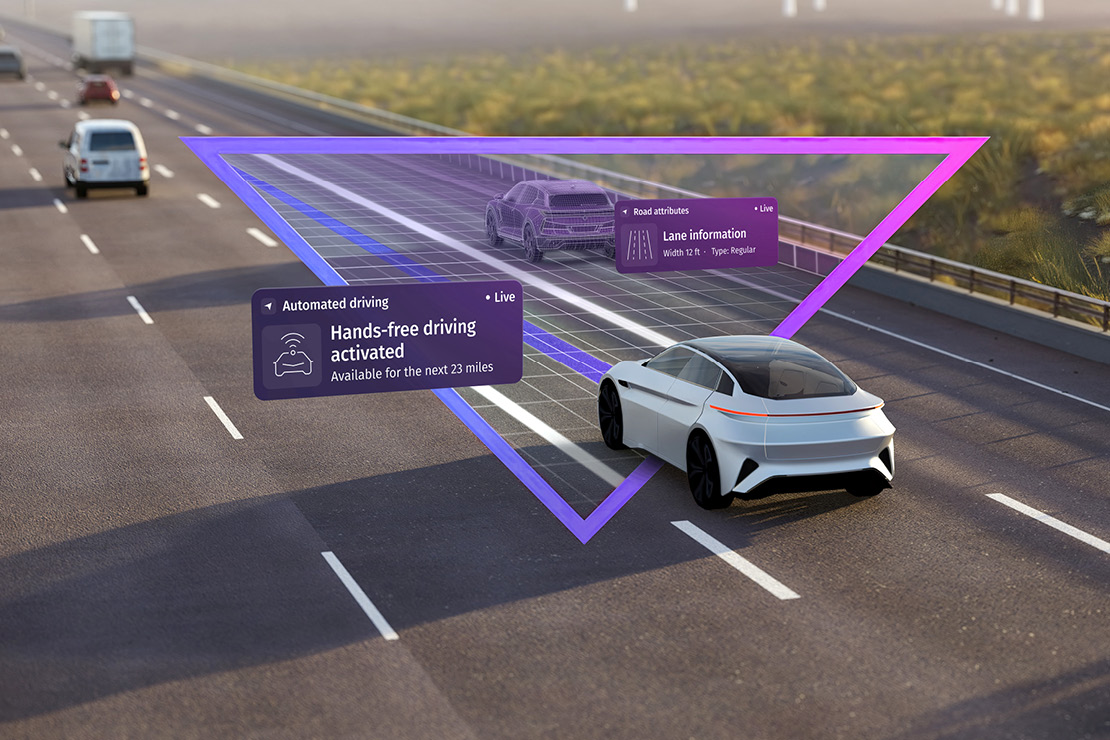
The HERE collaboration exemplifies how AWS works with other technology to advance the industry. In 2025, AWS entered into a ten-year, one-billion-dollar agreement to support AI-powered, live-streaming map and location services. What makes this distinctive is that it brings together HERE’s mapping expertise, AWS’s cloud and AI capabilities, and the conversational AI capabilities powered by Alexa+.
For OEMs, this means faster development with a uniquely branded conversational experience, while maintaining system independence.
What is your message to automotive leaders navigating the dual pressures of growth and industry transition?
There is no other industry as poised to benefit from AI as automotive. But to truly capture that advantage, you have to make speed an organizational mindset – and today, that means designing your entire enterprise around AI.
Automakers are sitting on mountains of data dispersed across countless systems. AI agents change that equation fundamentally. The technology exists today to move faster, increase agility, deliver better quality, and create personalized experiences – simultaneously. The question isn’t whether AI will reshape automotive. It’s whether you’ll be shaping that future or responding to it.