
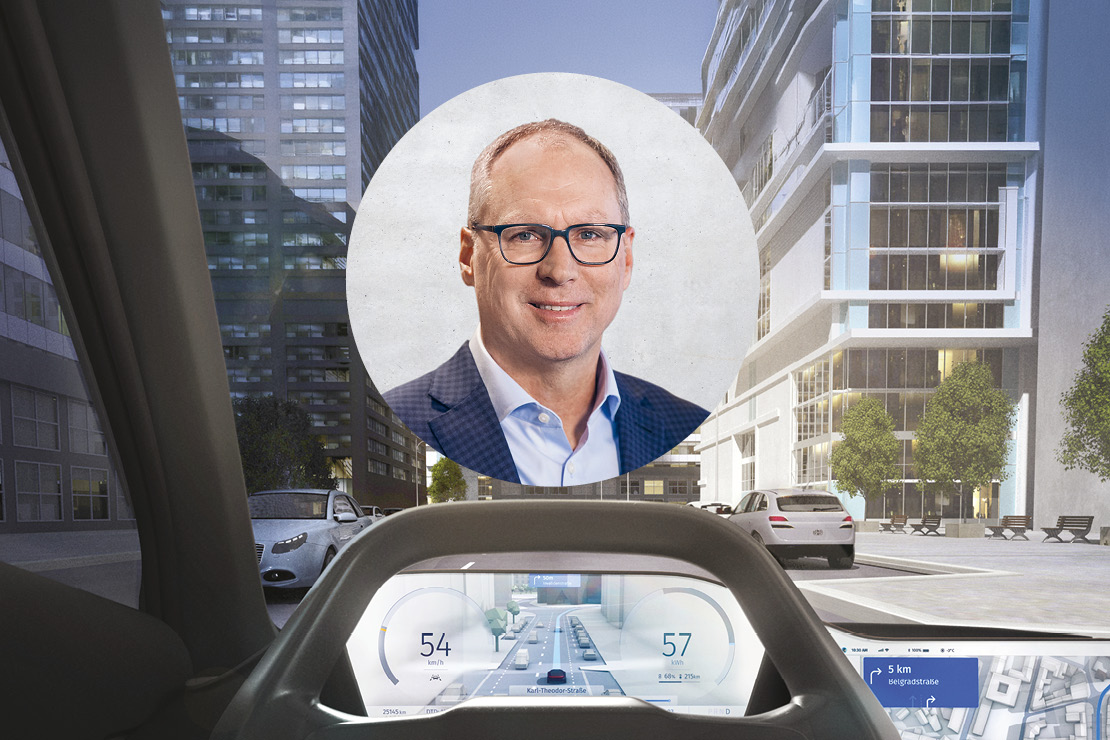
In Dialog with Mike Nefkens
Mike, you joined HERE Technologies as CEO in January 2024. What drew you to the company?
I’m a big car guy and a pilot, so I’ve been a longtime map enthusiast. HERE is about both cars and maps, which makes it the perfect combination. HERE also stood out as it’s the world leader in location data and next-generation mapping with decades of innovation experience, fantastic talent and an amazing customer base that includes virtually every OEM globally. Location data and technology underpin how people, goods and services move – powering automated vehicles, ADAS, software-defined vehicles (SDVs), AI models, logistics, smart cities, and more.
Leading HERE into the future and next growth phase was an opportunity I had to take, and it’s one of my best decisions.
We’ve had some strong momentum in recent years: HERE is recognized as the global location leader by leading analysts for nine years in a row, and we count 10/10 of the top 10 Chinese OEMs by export are using our location data. The company is growing quickly and investing in more innovation and quality, and our customers are noticing. I continue to wake up feeling energized and proud of the road HERE’s travelled, and excited for the journey ahead.
What do you see as major automotive industry drivers right now?
There are many, but three major ones are:
1. SDV acceleration: The car is being redefined: it’s no longer a static, hardware-led product; it’s a dynamic, software-defined platform that continuously evolves across its lifetime – that’s a gamechanger for how cars are built, how they’re upgraded, and how user experiences can improve over time.
2. AI everywhere: AI is transforming the industry, take agentic AI – where in-vehicle systems don’t just make recommendations, they can reason and act across maps, traffic, weather, rules and constraints.
3. Asian innovation speed: Chinese OEMs are leading in bringing innovations to market faster than others. Competitive pressure is rising globally for expedited timelines and cost efficiencies. The race is on to build better, faster and cost-efficient vehicles at scale.
These drivers make it an exciting time to be in the industry, and HERE is focused on helping our customers leverage location intelligence to compete effectively.
You mentioned HERE works with virtually every OEM. What types of solutions does HERE offer, particularly for SDVs?
HERE works with 90+ auto brands, providing enterprise-grade maps and location solutions across many use cases including navigation and digital cockpits, ADAS, automated driving, Intelligent Speed Assistance, EV services, and SDV development.
Traditionally, location data has been seen as a navigation feature, a sourcing decision, with multiple disjointed data sets, and a static map vs a live one. But in today’s SDV reality, location must be treated as fundamental and foundational infrastructure, not as a downstream component. It’s also all about: user experience, vehicles designed for speed and simplicity, and AI being built in.
HERE supports every phase of SDV innovation including helping reduce complexities and costs, and increase speed. Our solutions include:
– HERE’s SDV solutions package integrates our AI-powered live map and advanced software to unify navigation, driver assistance and autonomy across the vehicle lifecycle to reduce complexity, lower costs and deliver branded experiences
– SceneXtract, a software tool created with AWS for developers to make integration easier and development faster, more accurate and scalable when recreating real-world environments for ADAS and AD simulations
– SDV Accelerator, also co-developed with AWS is a collaborative cloud-based initiative for automakers to design, build, test and validate software to help accelerate development, reduce costs and time to market
– HERE Navigation and our unified mapping architecture for fresh and consistent vehicle-wide location data
– HERE SDK, which gives OEMs fast deployment and more control over the in-vehicle experience
– HERE AI Assistant, which transforms personalized travel planning by providing high-quality instant results to complex location-related queries from natural language prompts
With AI being a major driver, how do you view the role of AI in automotive and mapping?
AI is reshaping automotive across use cases, geographies and at every stage of a vehicle’s lifecycle. To best harness AI, foundational simplification is key: if your systems are clean and well designed, AI simplifies and accelerates. But, if your systems are fragmented, AI can add yet another layer of logic, integration, and complexity for engineers to manage.
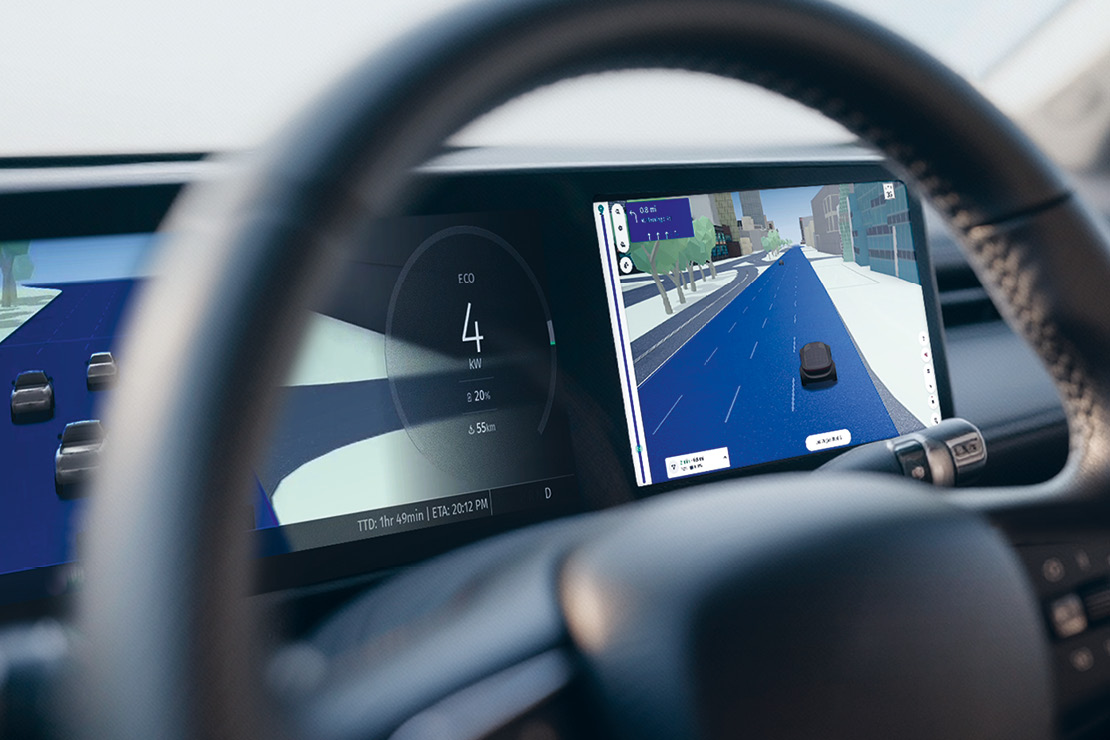
AI is certainly changing what a map is and what it can do. Over time, mapmaking has evolved from the download era (software updated yearly), to streaming (weekly / monthly updates), and now we’ve entered the AI live map era.
For years, the industry talked about living maps, real-time updates, and intelligent in-car assistants. What’s different now is that these things can finally converge at scale, including live, continuously updated location intelligence with AI that can reason about what’s happening in the real world, and natural, intuitive voice interaction. This is what enables a true, in-vehicle AI concierge – one that understands where you are, what’s happening around you and what you’re likely to need next.
For example, our deep partnerships with AWS and Amazon unite world class auto knowhow with industry leading solutions, such as with Amazon’s Alexa Custom Assistant to offer uniquely branded, conversational AI navigation for automakers.
Follow up question, what role does AI play in HERE’s strategy going ahead?
AI is key to HERE’s strategy as we continue to set the pace for innovation and serving customers.
One major way we use AI is to automate and industrialize mapmaking to improve freshness and accuracy while reducing complexity and cost. A huge advantage is our scale of data; we possess a huge amount of data, including ~500 million kilometres of probe and sensor data feeding HERE’s AI models every hour.
HERE continuously innovates in how we embed AI in our business, technology and products, but also in bringing AI location solutions to market.
For example, AI is quickly moving from answering questions to making real-world decisions, yet traditional LLMs remain limited in physical-world reasoning. Our new solution, HERE Location Reasoning, combines our enterprise-grade map data, live traffic and road intelligence to deliver reliable outcomes at scale. It will also improve speed, accuracy and cost efficiency for AI models and agentic systems operating in dynamic, real-world environments, including in the car. It’s a big step toward making agentic AI ready for high-stakes real-world applications across automotive, logistics, and enterprise operations.
Overall, a major goal of ours is to democratize AI-powered mapping, bringing advanced capabilities to every vehicle. The future of mobility depends on unified, AI-native platforms, and AI-driven live maps are key for faster innovation, safer vehicles and more efficient transport at scale.
Why do you think Chinese OEMs are moving faster than the rest?
Chinese OEMs are moving faster for structural reasons: tighter vertical integration, fewer vendor handoffs, faster decisions, and a strong focus on driver experience.
Other OEMs are not falling behind due to lack of talent, ambition, or engineering capabilities. It’s because the competitive model is fundamentally changing. We are moving away from traditional »Frankenstein« architectural systems towards software that is built to work together from the ground up. OEMs of all sizes and regions need to adapt to this change quickly.
The future of mobility depends on unified, AI-native platforms, and AI-driven live maps are key for faster innovation, safer vehicles and more efficient transport at scale.
Can you elaborate on what Frankenstein systems are?
Frankenstein systems are patchwork architectures built from multiple suppliers, map components, software layers and integration points that are stitched together. They may technically work, but they are complex; fragile to change and often result in high total cost of ownership; inconsistent user experience; and vehicles that come to market too slowly.
Do you think it’s possible for other OEMs to catch up to Chinese OEMs?
It’s possible, but value chain collaboration is vital. This includes OEMs, tier 1s + 2s, chip players, software and content providers coming together on next-generation partnerships.
HERE collaborates across the automotive value chain to catalyze advancements. Our collaboration with AWS is one example of how partnerships can help OEMs move faster.
Lastly, what are some pitfalls that OEMs should avoid to best move with speed?
Some top-of-mind ones are:
– Add complexity and call it innovation
– Drown in data and call it insight
– Use AI to amplify chaos
– Let procurement play the patchwork makers
– Make production the first real test
The winners in automotive will be those who can move fast, update continuously and design vehicles around a flexible software architecture rather than fixed systems.
Call me biased, but with HERE’s capabilities and ecosystem, we’re a great innovation partner to help OEMs act with speed and win in the market.