
In Dialog with Dr. Wolfgang K. Eckelt + Chris-Markus Kratz
Chris-Markus Kratz (CMK) is technology expert at the intersection of enterprise technology and industrial operations
Every manager believes he has extraordinary powers. But how long will these powers last? Going forward, only those who use the most advanced tools to their advantage will hold their ground at the top.
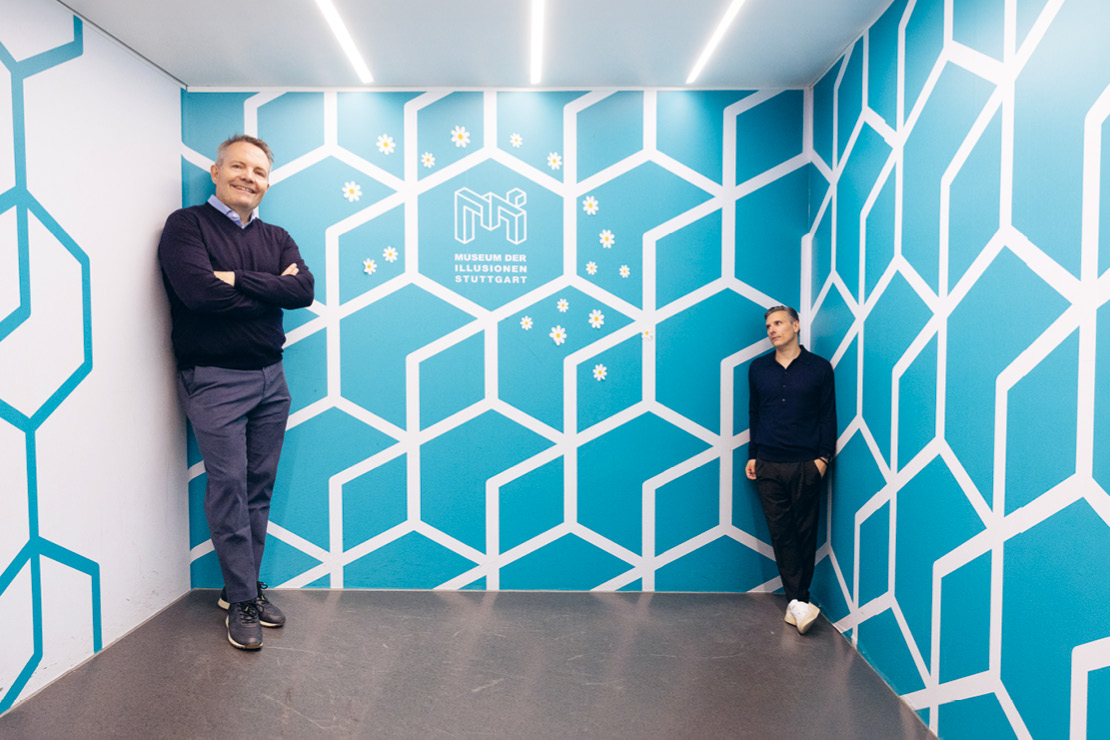
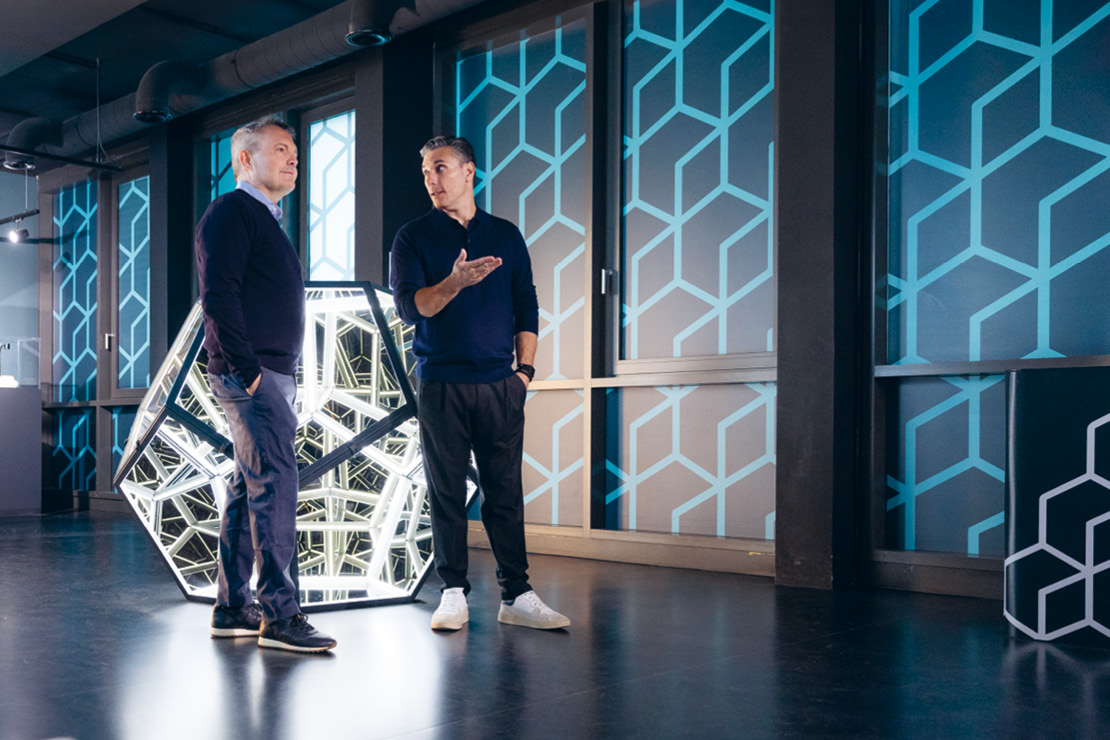
In this conversation, they explore how Artificial Intelligence (AI) is fundamentally redefining leadership – when decision-makers move from simply organizing work to orchestrating both people and machines. They discuss what executives must contribute in a world where AI can analyze information in fractions of a second, and why connecting IT, development, and production is emerging as one of the defining leadership challenges of the future. Few places could be more fitting for this conversation than the Museum of Illusions in Stuttgart, where familiar perceptions are turned on their head.
LET’S TALK ABOUT SUPERHEROS:
Wolfgang: You have come to the right guy. I have been a passionate comic fan since childhood.
»Where the danger is, also grows the saving power«, as Friedrich Hölderlin put it. What superpower does a decision-maker need in order to keep AI from taking his seat?
Wolfgang: Batman must save Gotham City!
How should I understand that?
Wolfgang: Gotham City is a rundown industrial city that has seen better days. The country that comes to mind does not take long to figure out. Gotham cannot save itself – and we will not get anywhere by carrying on like before. That is why we need managers with superpowers, and that brings me to Batman. He does not come from another planet like Superman and he has no superpowers. However, he knows how to work with his equipment. Without it, he would just be an ordinary CEO in a high-rise tower.
You mean Batman is nothing more than a fake in a superhero costume?
Wolfgang: No. When Batman swings between skyscrapers, it looks to people as if he can fly. In reality, a high-tech cape carries him – and only for a certain distance. But that does not make him a fake. He knows the capabilities and the limits of his tools, and uses them with care. Flying endlessly over the city is not an option – Flying endlessly above the city isn’t an option either – otherwise Batman would plunge into the concrete canyon below, and that would be the end of »just quickly saving the world«.
What does this metaphor mean when applied to the world of management?
Wolfgang: Many people feel threatened by AI, but they should not fear technology. They should use AI to optimize themselves. Just how Bruce Wayne, an ordinary man, can only become Batman with the right gadgets.
CMK: Keyword: AI is like a second brain for greater performance, not an outsourced service for more comfortable thinking. Many people think it is enough to use their chatbot to write summaries or emails.
Wolfgang: Exactly. AI is turning our world upside down. Anyone who thinks they can use AI to protect the routines they have grown fond of has not yet understood that they are already on the menu.
CMK: This message has not reached everyone yet, and a bad process does not improve with AI. The result is a bad process that now runs much worse and much faster.
So, you consider the narrative that »AI will relieve us all« to be a fairy tale if we think we can keep doing what we have always done?
Wolfgang: Working with AI takes more brainpower, not less. Because work shifts from production to evaluation, from execution to planning.
CMK: We are living through a disruption in our working world and a radical revaluation of skillsets. What is in demand is no longer about who does something, but who can tell whether it has been done well – regardless of whether it is done by a human or a machine. The full consequence of all this for the working world is something we have not yet grasped as a society.
Wolfgang: Politics is intellectually overwhelmed by it, and management is not much further ahead. The same question remains unanswered there as well: What remains of a top performer’s work when AI systems take over substantial parts of what they do? In the paralysis we find ourselves in, the answer must come from the boardrooms themselves.
CMK: We need to turn our processes on their head and ask whether they can survive at all. Transformations exist to challenge the habits we have grown attached to – all the way down to the operating logic of entire companies.

Studies have found that highly qualified knowledge work, in particular, is under pressure. How did that come about, and what does it mean in practice?
Wolfgang: The rhetoric of recent years has been nothing but a sedative. »The simple jobs will disappear, and more interesting ones will emerge«. Managers who repeated that mantra long enough never had to ask themselves the difficult internal questions. Now we see what is actually automatable: not the warehouse assistant, but the lawyer and the management consultant.
Which new professional roles are emerging?
CMK: The fear of job loss through AI exists, but it is framed in the wrong terms. AI changes which qualifications are in demand and ensures that we are dealing with mutants.
Wolfgang: Teenage Mutant Ninja Turtles?
CMK: Definitely not another superhero allegory (laughs). What I mean is that new key roles are emerging within existing professional fields: the Physical AI Integrator, who connects OT and IT in manufacturing; the AI Cybersecurity Specialist, who protects a company’s AI systems against targeted attacks such as prompt injection and data poisoning; and the Human AI Engineer, who teaches AI how a human thinks and behaves while working alongside machines.
How much trust can technology create?
CMK: Judgment, experiential knowledge, and the right handling of edge cases are values that cannot simply be synthesized. AI can produce text that sounds empathetic and deliver analyses that appear convincing. But from transformation projects, I know that success and failure usually have nothing to do with the technology. AI can serve as a scaffold that gives us structure, but it still has to be filled with the right materials.
Wolfgang: … such as empathy or the capacity to think visibly into the future. Genuine contact, lived experience, and intuition cannot be replicated by machines. Least of all: judgment under uncertainty. Relying on the predictive power of AI systems in unpredictable times is like building on sand. AI recognizes patterns and projects the past into the future. We should always keep that in mind.
CMK: Agreed.
CMK, where do you see concrete untapped potential for AI in industry, particularly in Germany?
CMK: Our prosperity came through factories, machines, and production systems. Germany sits on a treasure: decades of industrial data from manufacturing processes that are unique worldwide. To unlock that treasure with physical AI, we need to engage more seriously with decentralized data processing directly at the device or machine. That means bringing critical processing steps to the edge.
And that means …?
CMK: If we think about physical AI purely as a cloud extension and accept that critical processing logic moves into a data center, we will fail. Latency, security, and speed – those are what matter. If a signal from the cloud has to wait before a machine can respond, the system architecture is wrong. The decision logic has to go where the action is: in the facility, in real time, in the chip.
CMK, from your perspective as a technology expert: can an instinct for AI actually be learned at university or in vocational training?
CMK: At universities and in companies, we learn primarily how well someone completes a task. But we barely learn how well someone decides, how well someone delegates, or which tasks should be done by whom or by what.
Wolfgang: A structural problem that runs from the bottom all the way to the top …
CMK: In mathematics, the path to the solution was always more important than the result. Intelligence is directly connected to unconventional and critical thinking. That applies to AI today: the machine delivers the result. But whether the path is right, whether the premises are valid, whether the conclusion makes sense or whether risks arise along the way – that remains in human hands and grows more significant by the day.
Wolfgang: At management level, people talk about future skills. But they rarely start with themselves. Leadership teams feel the technological shift too and struggle to explain themselves when AI systems think better and deliver sharper analysis than the decision-makers.
When a management team wants to introduce an AI system, it needs to understand how that system works: Which documents feed into it? What logic is it built on? Where are the risks?
CMK
And the knowledge itself – on which the modern working world in industrialized nations is based – how much longer will it hold?
Wolfgang: Let me put it differently: do we even need managers anymore or can the machine do that too?
CMK: Many ask themselves that question. Almost no one dares say it out loud.
Wolfgang: My answer is yes, we need them. But not for what we have paid them for until now. Anyone whose core competency lies in gathering information and preparing decisions is on thin ice. AI systems do that faster and cheaper. What remains is tolerance for ambiguity, emotional intelligence, and resilience.
If AI systems are not the sole solution – what is?
Wolfgang: That is why many companies are bringing the experienced ones back right now. The wise and weathered. The people who know crises, who know cycles, and who know what it means to fail. People who understand that markets do not follow models. AI is a navigation system, but whoever sets the course and bears the risk must be human. And in a storm, you do not hand the rudder to a novice.
What is happening technologically right now which we might be overlooking?
CMK: Language models are being tailored more precisely to specific sectors. Technology companies have developed training data for language models in finance, law, education, and office contexts with ever greater focus. The result is visible in the new frontier models: they keep growing more capable and compete with human knowledge workers across more and more domains.
Wolfgang: … but only when you look at individual tasks, not the entire work system.
CMK: What boards have not yet recognized is this: in some of the professions most affected, younger people can barely find entry-level jobs anymore because companies are cutting junior positions for short-term gains and replacing parts of their work with AI.
Wolfgang: That sounds like efficiency, which is what managers are looking for, but they are overlooking the long-term consequences. Whoever does not hire juniors today will have no seniors in ten years’ time – especially when today’s seniors are about to retire. Knowing how to classify knowledge, weigh it, and apply it at the right moment is something that develops over years. It only grows through experience. That is why we need to find a way to make better use of the expertise of experienced professionals at the management level while giving younger people the opportunity to prove themselves.
New demands at work – does that affect leaders too?
Wolfgang: Especially in the AI era, the classic leadership and problem-solving skills count: framing challenges, describing results, recognizing when something is wrong, and fixing problems creatively.
Would you say that what becomes more valuable is knowing what to ask and which ideas can be connected into something new?
Wolfgang: Decision-makers remain decision-makers. Full stop. But you go from Robin to Batman when you ask your AI oracle the right questions and interpret its answers correctly. Perhaps we need a new job title: Chief Question Officer – the coordinator of agents.
CMK: More than ever, we need the ability to make judgments under uncertainty, to understand systems, to translate knowledge into processes, and to recognize when something is wrong.
Wolfgang: Like the management generations before us in a crisis, we are navigating on sight – but now with different instruments that require new competencies.
Gut instinct and judgment have long been seen as the qualities that distinguish leadership decisions from algorithms. Is that still defensible – or should CEOs deliberately use AI to make better decisions?
CMK: AI feels nothing, and in some cases that can be an advantage. Imagine a digital twin that knows a CEO inside and out – his decision-making style, his patterns under pressure, his weaknesses, and his routines. It can point out something that is rarely said in the room: that a reaction may fit his personality but not the situation. Beyond that, AI can see the forest through the trees in confusing situations. It recognizes patterns and correlations in enormous datasets in fractions of a second, at a speed no human can match.
Crisis communication is a good example. People under pressure think differently. Fear, loyalties, and expectations shape what gets noticed, what gets overlooked, and what gets glossed over. AI does none of that. It analyzes situations coolly, identifies pitfalls without concern for internal sensitivities, and brings an outside perspective to a situation that everyone else can see only from within.
For a long time, CEOs in the auto and manufacturing industry, for example, came from production or rose through the ranks internally. Do they have to become more technical in future?
Wolfgang: They do not need to code. But anyone who cannot work through unfamiliar logic has no place at the top any more. The leader of the future sits at the intersection of IT, development, and production. Three worlds, three languages and three priorities. Learning to speak multiple languages within your own company – that becomes increasingly important for managers.
CMK: Whoever knows only one of these worlds translates poorly. Whoever understands all three is hard to replace. When a management team wants to introduce an AI system, it needs to understand how that system works: Which documents feed into it? What logic is it built on? Where are the risks?
Especially in the AI era, the classic leadership and problem-solving skills count: framing challenges, describing results, recognizing when something is wrong, and fixing problems creatively.
Wolfgang
And in the final analysis, what does that mean for a CEO?
Wolfgang: The CEO’s environment is the most sensitive point in any company. That is precisely why it needs AI. What it needs is more people at the top who know when to trust the machine and when to think for themselves. Where a situation is ambiguous, complex, and deeply human, that is where the territory begins. No one should hand this over – because that kind of knowledge is not stored in any model. It is a bit like mountaineering: the first stretch you take the cable car. But for the summit, you strap on crampons and walk the final meters yourself.
CMK: My case for going retro! The human qualities that will gain value in the age of AI are sensitivity and genuine empathy. Physical presence, intuition, and gut instinct. Much like the vinyl record. It did not disappear with the rise of digital streaming. On the contrary, it is experiencing a renaissance in DJ booths and living rooms around the world because some things become more valuable as the world moves faster.
To finish up, let’s look ahead: where will we stand in ten years when leaders are using AI to their advantage?
CMK: Health, prevention, and longevity will become sought-after goods. Especially when managers are under greater cognitive load than ever. The informed entrepreneur therefore invests in his own capacity to perform as a strategic asset. Body, mind, and network are capital. The most valuable he possesses. AI-assisted personalized medicine, preventive diagnostics, and mental health will become growth markets in the next decade.
Wolfgang: The world is sinking into the swamp. But it is not lost. Every crisis has produced leaders who rose to the challenge and broke through resistance. The same will happen now. I am no superhero, but I am optimistic. So put on your cape, fasten the gadgets to your belt, and start the engine. Gotham City is calling for Batman!